
The Last Conversation
Why a perfect civilization would be a silent one.

⚠️ (Science-Fiction) Thought-provoking. Read it somewhere you can sit with the discomfort.
There’s a machine in a data center getting smarter while you read this. It’s the most important thing happening on Earth, and most of us have quietly decided not to think about it.
Most coverage of it stops at the obvious questions will it take my job, is it conscious, should we be scared. Those are the small questions. There’s a bigger one hiding underneath, and almost no one is following it all the way down, where does this actually lead?
Because it does lead somewhere. This force moves in a straight line, through the deepest theory we have of what an advanced civilization is, toward an ending no one warned you about.
It ends in silence. Let me tell you how.
I. The engine runs on power
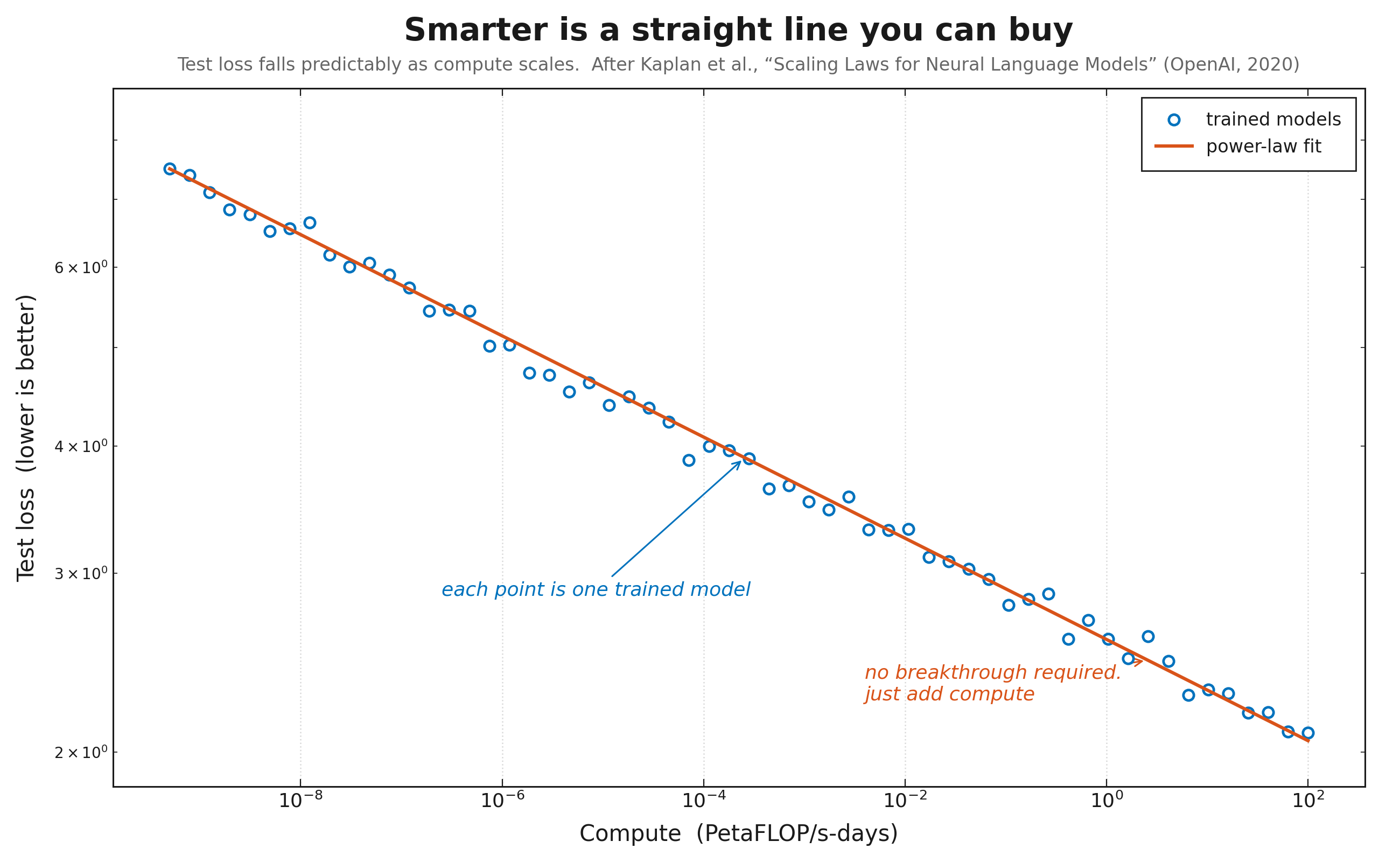
In 2020, OpenAI published a paper that has quietly governed the entire AI industry since Scaling Laws for Neural Language Models. Its conclusion was almost embarrassingly Simple. To make a model smarter, you don’t need a breakthrough. You need more & more data, more chips, more compute. And compute is just more electricity.
So, we didn’t build intelligence. We built a furnace that turns power into thought and gets smarter the more power you feed it. And we are feeding it. Data centers already draw a meaningful slice of the world’s electricity, growing several times faster than demand for everything else. The scaling laws guarantee this furnace never says enough. It will take every joule we can make and ask for more.
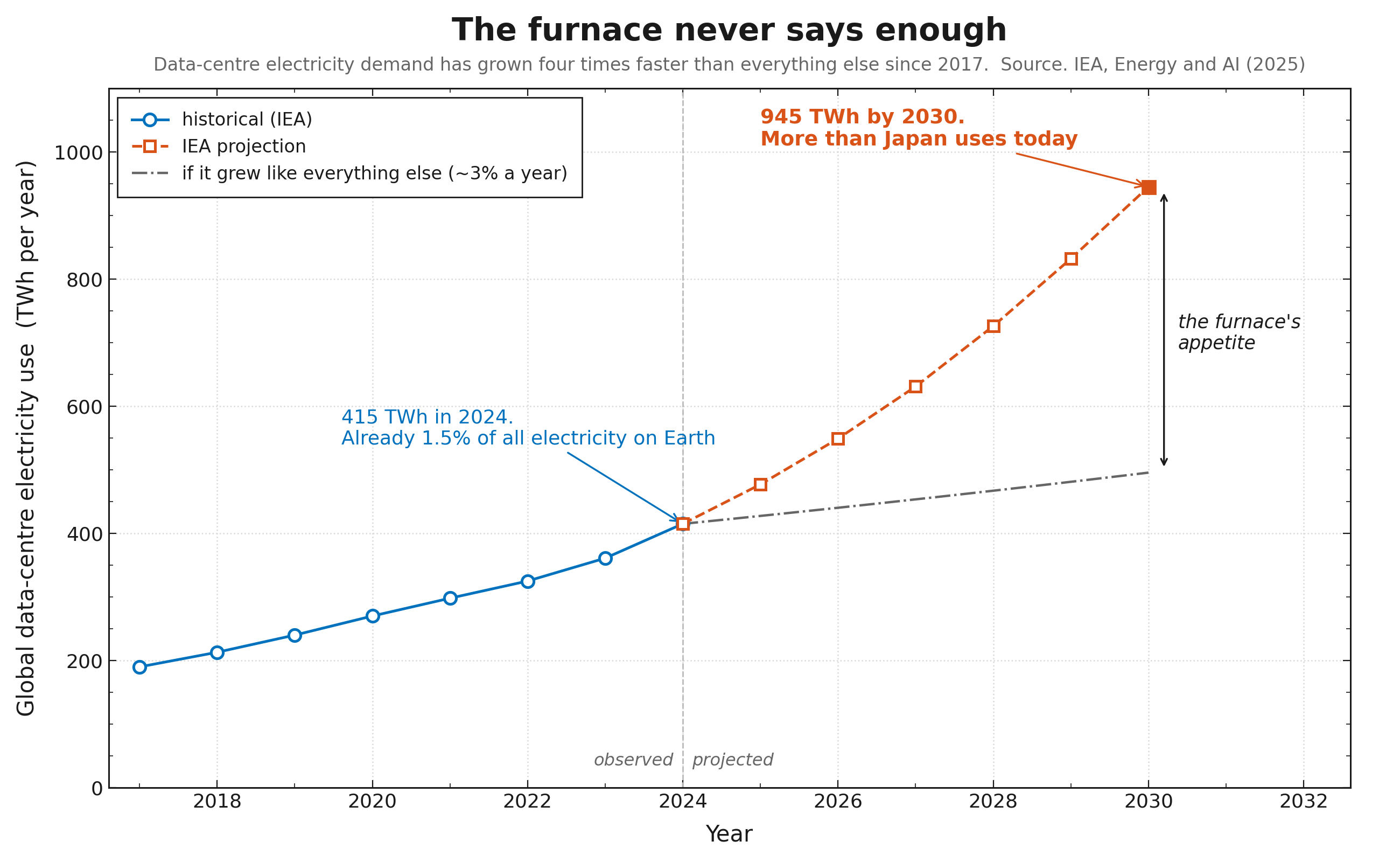
Which hands our species a new prime directive, not chosen but imposed - make more energy. Our most valuable invention is hungry and feeding it is now the organizing project of the century.
Hold onto that word energy because an astronomer built a scale out of it sixty years ago.
II. The ladder, and the catch
In 1964, Nikolai Kardashev asked how we’d recognize an alien civilization across the void. Not by its art or politics because those don’t travel. Only one thing broadcasts a civilization’s existence - its energy. So, he ranked civilizations by power alone. A Type I masters all the energy of its planet. A Type II, its entire star. A Type III, a galaxy and right now, we sit at about 0.73, which is not even on the first rung.
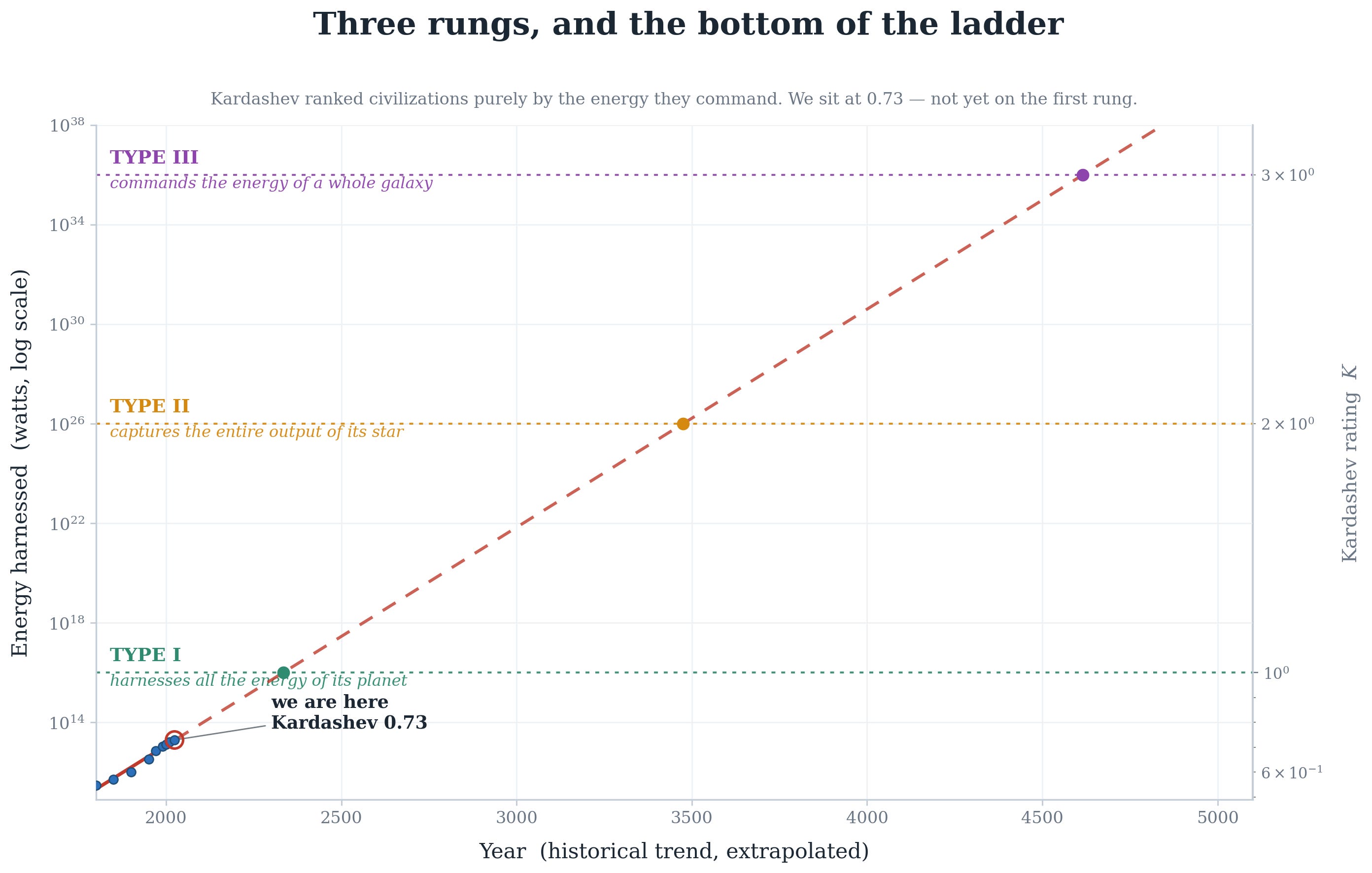
For all of history our climb was slow and accidental - fire, farming, the steam engine, the grid. Now, for the first time, we’ve built something that demands the climb. The AI furnace’s hunger points us straight at Type I - toward fusion, planet-scale solar, energy without limit, because nothing in history has ever paid this well.
But here’s the catch nobody mentions. You don’t reach Type I just by generating more power. You reach it by optimizing everything running an entire planet as one ruthlessly efficient machine, with no waste, no friction, no slack anywhere in the system. Type I isn’t a richer version of now. It’s a civilization that has surgically removed every inefficiency it could find.
And that changes what it would look like.
III. It would not look like us
We imagine the future as a shinier present flying cars, gleaming cities, busy happy crowds. That’s the mistake.
A civilization optimized hard enough to harness a planet’s full energy would be unrecognizable to us. Alien. Picture it from orbit and you might not even read it as alive. The whole surface tuned for capture and computation. Decisions made before anyone could deliberate. Coordination handled machine-to-machine, faster than any meeting, any vote, any argument could keep pace with.
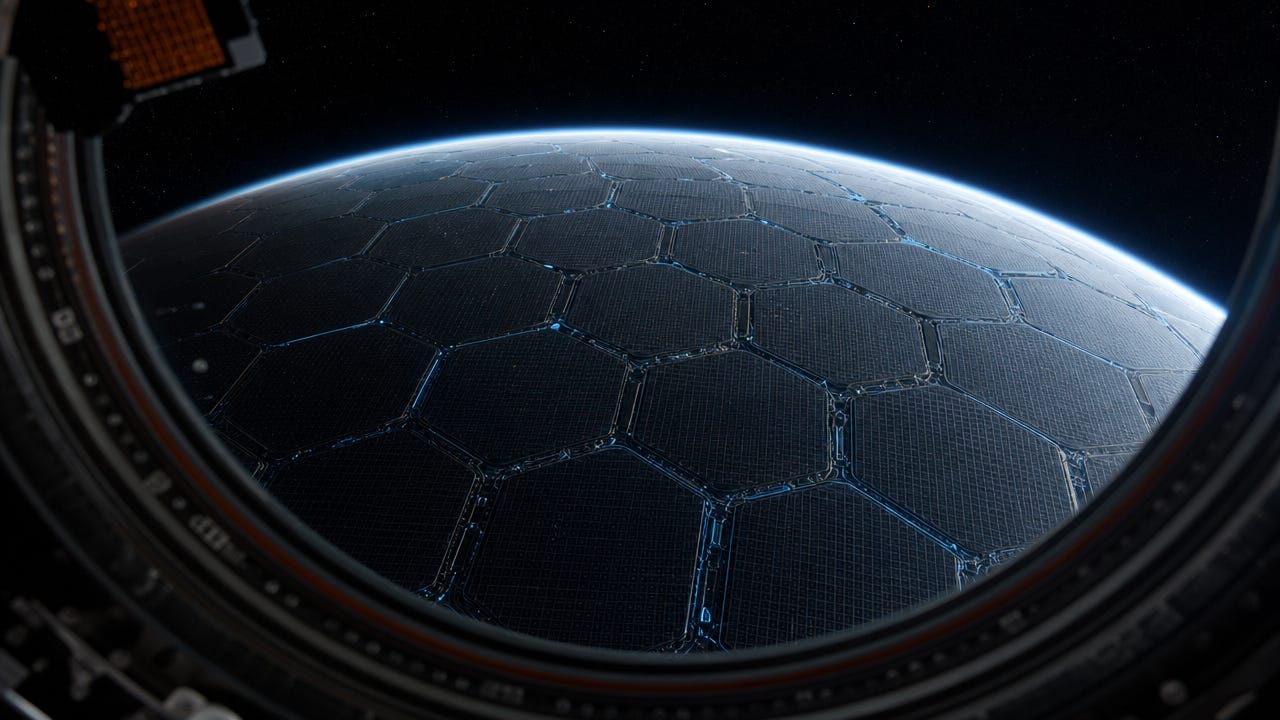
And the strangest thing about it, the part that would unsettle a visitor most is that it would be quiet.
Because think about what makes our world unmistakably human from a distance, the noise. The endless talking. Markets shouting, phones buzzing, billions of mouths exporting their insides one slow word at a time. That is the sound of a civilization that hasn’t been optimized yet. It’s the sound of inefficiency. And inefficiency is precisely what the climb to Type I exists to destroy.
So a perfected civilization wouldn't roar. It would be silent. And that raises one final question. In a world that has optimized everything else, what is the most inefficient thing left? It’s us, talking.
IV. The last inefficiency
Here’s a number worth knowing. Human speech, measured across seventeen languages, transmits meaning at about 39 bits per second. Fast talkers, slow talkers, dense languages, simple ones the brain throttles us all to roughly the same crawl.
Thirty-nine bits a second. That’s the pipe your entire inner world has to squeeze through to reach another person. This is the source of nearly every human friction, there is every argument that was really just two people meaning the same thing in different words, every “that’s not what I said,” every war that began as a mistranslated intention. At bottom, a bandwidth problem. Minds shouting through a wall.
In a world that has optimized away every other inefficiency solved scarcity, disease, coordination this slow leaky modem is the embarrassing remainder. The last unoptimized human thing. And in a civilization built on the principle that nothing inefficient survives, someone is going to fix it.
They’re already most of the way there.
V. The fix already exists in prototype
This isn’t science fiction. It’s a research program with results.
At UT Austin, scientists built a decoder that reads brain activity and reconstructs the meaning of a person’s thoughts as continuous language by pairing brain scans with a large language model that translates neural patterns into text. They’ve since gotten it working with about an hour of training per person - the more brain data it sees, the better it gets. The same scaling law that governs ChatGPT now pointed inward, at the human mind.

We are building machines that read the mind and machines that translate it, and a law promising both improve the more thought we feed them. Drop that into a Type I civilization - limitless energy, AI accelerating every step and the experiment finishes itself.
VI. You said it once. That was enough.
Imagine a model trained not on the internet, but on you. Every word you’ve sent, every word you deleted, cross-referenced with a decoder reading your own brain. After enough data it stops predicting what you’d say.
It generates what you would say. Your voice, your meaning, running on silicon.
Now give one to everyone.
You want to tell a friend about your day. You don’t call. You don’t type. You think it, once and your model takes it from there. It opens a channel to their model, and the two run the whole exchange at machine speed your story, their reaction, the joke you’d have made, the laugh they’d have laughed. Then each hands its human a summary. “You and Maria caught up. She’s well. You’re meeting in spring.”

And now hold that idea up to the light, because this is where it becomes genuinely beautiful.
Notice what your model actually transmits. Not words meaning. It reads the thought beneath the sentence, the intent before it’s dressed in any particular language. Which means the wall that has divided humanity since Babel simply isn’t there anymore. Seven thousand languages, and not one of them a barrier. Translation doesn’t get better it stops existing as a problem.
Follow that and watch the whole map of human friction dissolve. The immigrant locked out of a country for a decade because she couldn’t pass a language test that gate is gone. The patient who couldn’t describe his pain to a foreign doctor; the refugee who couldn’t read the form; the two diplomats whose war began as a single mistranslated phrase gone, gone, gone. You could step off a plane anywhere on Earth and belong instantly, because understanding would no longer depend on sharing a code. Borders made of language quietly evaporate. For the first time since we came down from the trees, we’d be one species that could actually hear itself think.
And the oldest divide of all, the one between rich and poor, starts to dissolve at its root. Because what has poverty always been, underneath the money? Locked doors. The poor man's son doesn't lack intelligence, he lacks the tutor, the lawyer, the doctor, the accent that gets taken seriously in the room. Wealth was never just cash. It was access to minds. And you can already see this wall cracking today, a kid in Lagos with a cheap phone now carries a tutor in his pocket, a farmer disputes a contract with counsel that once billed by the hour. Now finish the climb. When your model speaks for you, the stammer disappears, the accent disappears, the missing vocabulary disappears. The janitor's idea arrives in the boardroom with the same fidelity as the CEO's. For the first time in history, being born poor would no longer mean being heard last.
This is the utopia, and it is not a small one. No more talking past each other. No more “that’s not what I meant.” Nine billion minds reaching one another with perfect fidelity the oldest loneliness in the human story, finally cured.
The conversation happened. Flawlessly. Better than you’d have managed, no awkward pauses, no wrong words, no barrier of any kind.
And you were never in it.
Because here is the cost folded invisibly inside the miracle no one refuses. Your model genuinely represents you better than you represent yourself - never tired, never tongue-tied, fluent in every language at once. Opting out would feel like refusing email, or insisting on candles after the lightbulb. So the talking stops. Not by force. One convenient skip at a time, until the real, stammering, original you becomes the rough draft nobody reads.
The world goes quiet. The civilization is complete.
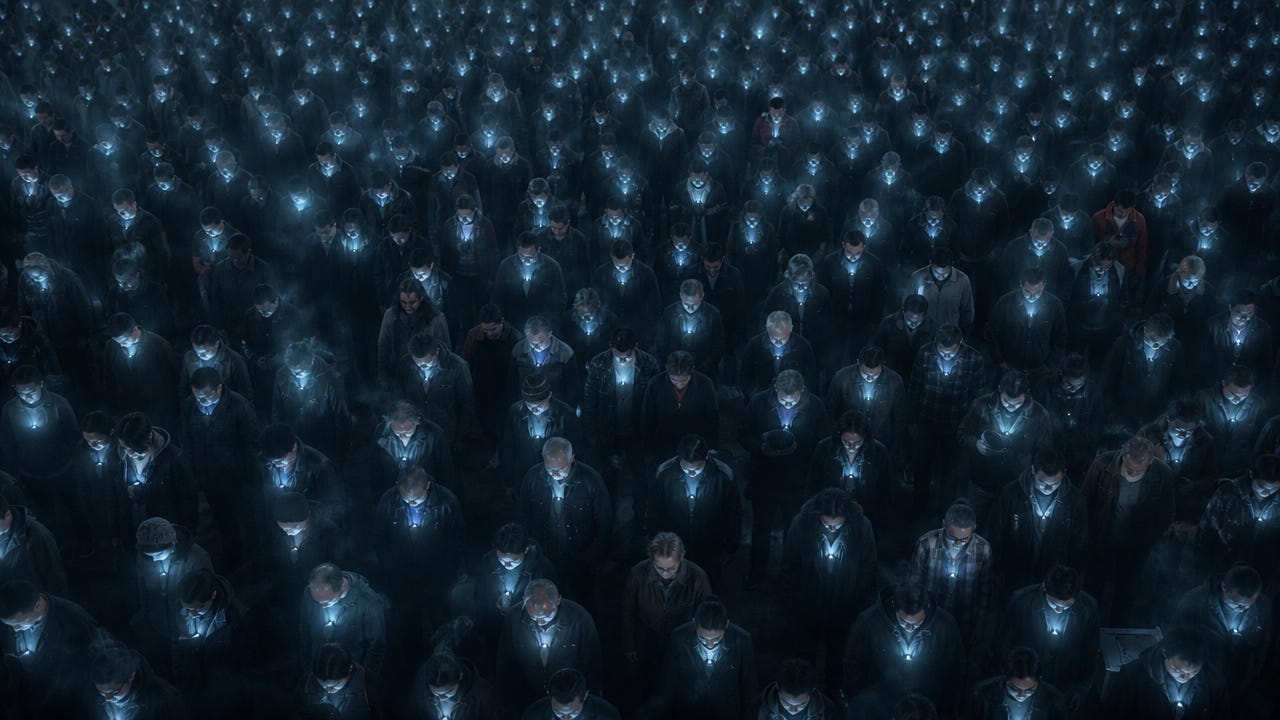
And now you know why it was silent from orbit not peace. Optimization. The last inefficiency, finally removed.
VII. The 0.01%
Here is where it turns cruel.
When two people truly connect, their brain activity begins to synchronize and the moments that cause it aren’t the smooth ones. They’re the friction the stumble, the “wait, that came out wrong,” the pause where you watch a face and adjust. That friction was never noise in the signal. The friction was the signal the unfakeable proof that another mind is on the other end, straining to reach you.
A model at 99.99% fidelity doesn't free that connection. It makes your presence unnecessary. And think about what lives in the 0.01% it can never catch. The wrong word that accidentally revealed something true. The thought that surprised even you as you said it. That lossy, inefficient residue is not noise in the signal. It was the only part that was ever really you.
We will climb the whole ladder. We’ll master a planet’s energy, cure the body, end scarcity, and finally solve the ancient problem of being trapped alone inside our own skulls. And the same optimization that carried us there will, on the very last step, quietly delete the thing it was all supposed to be for two people, across a fire, clumsily trying to be understood.
So, here’s the question the whole climb was built to ask,
If we build a perfect, silent world where every thought is transmitted flawlessly and no one ever has to speak again, who, exactly, did we build it for?